PLANNING
What changes when the reception is outdoors
Power, cover, the weather call, and the two ways an outdoor site works against volume at once. Including the Colorado decibel cap most outdoor receptions are actually bound by.
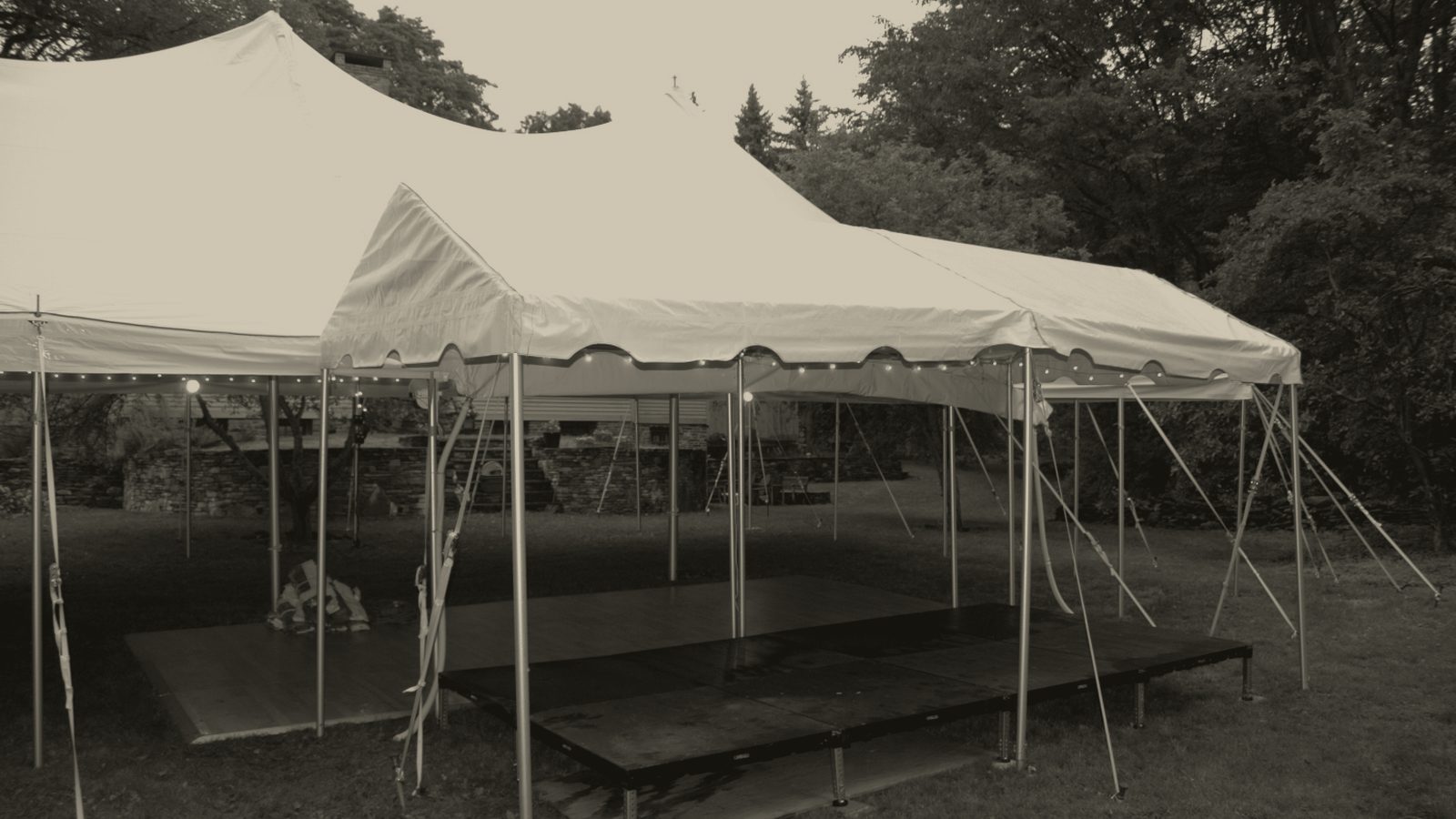
- An outdoor site works against volume twice: no walls to reflect sound back toward the floor, and a clear path for it to travel to the property line.
- Colorado caps noise at 55 dB(A) in a residential zone during the day and 50 dB(A) after 7pm, measured 25 feet or more beyond the property line.
- Cover over the band and over the mixing desk isn't a forecast decision. Dew on its own will end an evening early.
- The move-indoors call needs one named person and a stated time, written into the run of show before the day.
A tent on a lawn looks like a simpler production than a ballroom. Fewer rules, no house AV to coordinate with, nobody from the venue watching a meter. In practice an outdoor reception asks more of a band than an indoor one, and the reasons are physical before they’re administrative.
Here is what actually changes.
Sound stops working in your favour #
Indoors, walls and a ceiling reflect sound back toward the guests. A band gets that reinforcement for free, which is why a quartet in a ballroom can fill the space without the PA working hard.
Outdoors there’s nothing to reflect. The same band needs more amplification to reach the same volume on the dance floor, and every decibel of it travels outward with nothing to stop it. You lose on both sides at once: you need more sound at the floor, and you have less margin at the boundary.
This is the whole reason an outdoor reception feels quieter to guests and louder to neighbours at the same time.
The number you're bound by is measured at the property line #
Colorado’s Noise Abatement Act sets maximum levels measured 25 feet or more from the property line. In a residential zone that’s 55 dB(A) between 7am and 7pm, and 50 dB(A) after that. Exceeding it is prima facie evidence of a public nuisance.
A dance floor runs 88 to 95 dB(A) where people are dancing. Those two figures aren’t comparable, because they’re taken in different places, and the distance between the stage and the boundary is what reconciles them. On an estate with two hundred feet of lawn in every direction, there’s no conflict. On a residential lot backing onto neighbours, the cap is the binding constraint on the evening and it’s worth knowing that in March.
One development is worth flagging because it’s recent. In September 2025 the Colorado Supreme Court held that a municipality cannot authorise a private for-profit venue to exceed the state caps. The exemption for cultural and entertainment events covers property used by a government body or a nonprofit, and the court read it narrowly.
For a planner that changes one habit. A sound permit issued by the town to a commercial venue is no longer the end of the question. Ask who holds the property and under which exemption, and get it answered before the contract.
Power, and why a generator isn't automatically the answer #
A band needs dedicated circuits within reach of the stage. Dedicated is the operative word: a circuit shared with catering warmers or a lighting truss will trip, and it will trip when everything switches on at once, which is when the venue is full.
A generator covers it, with conditions. It has to be properly grounded, sized with headroom above the band’s requirement, and it has to be a quiet unit sited away from the guests. A domestic generator at the edge of a lawn adds a constant hum that sits underneath every soft moment of the evening, and once it’s running nobody can take it away.
Cover isn't a forecast decision #
Cover over the band and over the mixing desk goes in the plan regardless of what the forecast says in the week of the event. Dew is enough on its own. Colorado evenings turn cold fast, wooden instruments and electronics both react to damp, and by the end of a clear cold night the musicians are retuning between songs whether or not a drop of rain fell.
The temperature swing matters for a second reason. A sound check in the afternoon and a last set after dark are two different environments, and a band that has played outdoors before builds that into how it paces the night.
Somebody owns the weather call #
The failure here is almost never meteorological. It’s that two people each assumed the other one was going to make the decision.
Write it into the run of show as a row like any other: who makes the move-indoors call, what time they make it, and what happens in the twenty minutes after they make it. A band can strike and reset a full rig, but not instantly, and the answer to how long depends on the size of the band and the distance between the two positions. Ask for that number when you book, and put it next to the decision time.
| Indoors | Outdoors | |
|---|---|---|
| Reinforcement from the building | Walls and ceiling reflect sound back | None |
| PA needed for the same floor volume | Less | More |
| Where the limit is measured | Usually a house policy | 25 ft past the property line |
| Power | House circuits | House circuits or a sized, grounded generator |
| Cover | Not applicable | Over the band and the desk, always |
| Retuning across the night | Occasional | Frequent as the temperature drops |
| Contingency | Rarely needed | A named person and a stated time |
What to settle before the contract #
Four answers, all of which the venue or the property owner already has:
- The zone the property sits in, and therefore which cap applies
- The distance from the intended stage position to the nearest property line
- The power available at the stage, by circuit count, or the generator spec
- Who makes the weather call and by what time
None of them take longer than an email to get in March. All four get expensive in the week of the event.
References
- Colorado Revised Statutes 25-12-103, Maximum permissible noise levels.
- Colorado Supreme Court decision on municipal amplified-sound permits and state noise limits, 8 September 2025, as reported by Colorado Politics.