PLANNING
How loud should background music be at a party?
Background music should sit at a level people can talk over. Here's what that sounds like in plain terms and in decibels, how the size of the act and the space change it, and whether a singer works over dinner.

- Background music at a party should stay low enough that everyone can talk in their normal voice. For a planner, that's 60 to 65 dBA at the table nearest the musicians.
- Live musicians can adjust to how loud the crowd gets, one song at a time.
- Instrumental music is the easier kind to talk over, and a singer with a guitar plays at the same conversation level.
Think of the best dinner party you’ve been to. You and the person across the table talked all evening without leaning in, and every so often one of you stopped mid-sentence because a song you both knew had come on. That’s the level background music should sit at, and it’s where our musicians stay through cocktails and dinner.
How many decibels should background music be? #
It should be about as loud as the conversation around it. That means two people standing next to each other can talk in their normal voices, and a guest at the far end of the party can still pick out the tune. If the venue or the run of show needs a number, write down 60 to 65 dBA, measured at the table closest to the musicians.
An evening with a program or a dance floor in it has more than one level, and a planner can put all of them in writing:
| What guests hear | Measured | |
|---|---|---|
| Cocktails and dinner | Music the nearest table can talk over in normal voices | 60 to 65 dBA at the nearest table |
| Speeches, awards, anyone else on a microphone | The music stops | Silent |
| Dancing | Loud enough to dance to, too loud to hold a conversation on the floor | 88 to 95 dBA on the floor |
| The last hour of dancing | The loudest point of the night | Peaks of 100 dBA |
What the research says about music and conversation #
Acoustics research on restaurants and banquets has measured where conversation stops working. Two people an arm’s length apart can hold a comfortable conversation while the total sound around them is at about 71 decibels or less. For a round table of ten to talk across, it needs to be about 59. At 77 decibels, a guest can only talk to the person right beside them.
One large banquet, measured in three halls, ran at 83 to 87 decibels. The same research recommends background music at no more than 60 to 65 decibels, which is where our dinner level sits.
A party also gets louder by itself. Once the background noise passes about 45 decibels, people raise their voices by about half a decibel for every decibel of noise. Since everyone does it at once, the whole party just gets louder, and it doesn’t get any easier to hear each other. Music adds to that total, so it helps to have musicians who can adjust the level as the crowd gets louder or quieter.
It’s different again for older guests. In the United States, 22% of people aged 65 to 74 and 55% of those 75 and older have disabling hearing loss. In a 2022 lab study of 31 adults over 60, understanding speech began to slip when the background reached about 51 decibels. So at a party with grandparents, it’s kinder to keep the music quieter and to seat them away from the speakers.
Can guests talk over live music? #
Yes. Musicians hear the party they’re playing for. A crowd gets louder as more people arrive and softer when people step outside, and a duo can follow that change with the next song, so the music stays easy to talk over for the whole event.
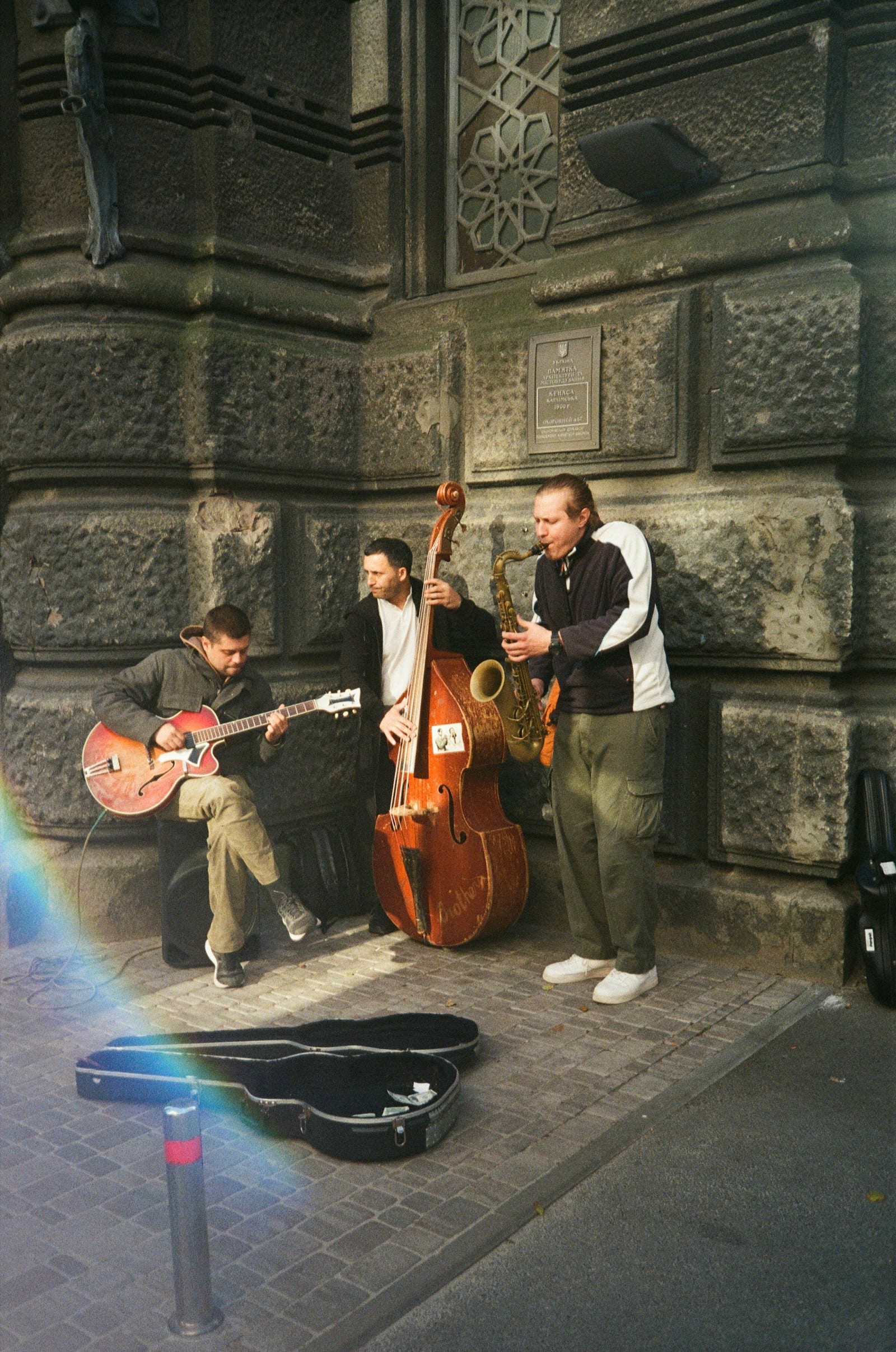
The other half of it is matching the size of the act to the headcount. A duo of guitar and upright bass is a great size for a dinner of twenty to sixty. Past sixty guests, a trio adds a drummer playing with brushes rather than sticks, which gives a bigger crowd a steady beat at the same volume.
Instrumental or vocals when people are talking? #
Instrumental is the easier one to talk over, because the only words in the air are the guests’ own. Instrumental acts on our roster include the jazz duo, the Spanish guitarist and classical strings, and they’re all excellent choices for an event that’s mostly conversation.
Lab studies agree that sung words compete with speech more than instrumental music does. In one, 30 students read a passage in quiet, with instrumental music, or with songs that had lyrics. They understood it about as well with instrumental music as in quiet, and worst with lyrics, whether or not they liked the songs. These are lab studies of reading and memory, though, and as far as we know nobody has tested it at a dinner.
A singer works too. A singer and guitarist can keep the voice at conversation level, so anyone who wants to follow the words can, and the next table can keep talking at its own volume.
How the space changes the level #
In a small space, a guitarist, a duo or a string quartet can play with nothing plugged in at all, and a pianist can play a stage piano with just a little amplification. A ballroom is the opposite case. The musicians bring a sound system so the back tables can hear the tune, without making it any louder at the tables nearest them.
Outdoors, a guitar is close and warm for about thirty feet and fades after that, because there are no walls to send the sound back toward the guests. An outdoor party usually needs a small sound system for that reason, turned up just enough to reach the edge of the party at conversation level.
What if the venue has a volume limit? #
Give us the venue’s limit when you book. Once the musicians know the number, they can choose instruments and arrangements that fit under it, and the music can still sound great.
In a residential zone, Colorado caps noise at 50 dB(A) after 7pm, measured 25 feet or more beyond the property line.
Music for a company holiday party people can talk over #
A company holiday party puts people from different departments at the same tables, so most of the evening is conversation. Our Christmas jazz trio is an excellent choice for that kind of party, playing Christmas music by Vince Guaraldi and holiday standards on guitar, upright bass and brushed drums, at conversation level. If your company wants a dance floor as well, you can book a band, and a band can play dinner at the same level the trio does.
Our artists have played for Amazon, NBCUniversal, Charles Schwab, Kroger, the Denver Art Museum, Sheraton, Hyatt, the Washington Nationals, Casa Bonita and Monarch Casino.
Sources
- Rindel, J. H. (2019). Restaurant acoustics: verbal communication in eating establishments. Acoustics in Practice. Read the source
- National Institute on Deafness and Other Communication Disorders (2024). Quick statistics about hearing. Read the source
- Bottalico, P., Piper, R. N., and Legner, B. (2022). Lombard effect, intelligibility, ambient noise, and willingness to spend time and money in a restaurant amongst older adults. Scientific Reports. Read the source
- Perham, N., and Currie, H. (2014). Does listening to preferred music improve reading comprehension performance? Applied Cognitive Psychology. Read the source